

Wine Ratings Explained
Wine ratings are one of the most useful tools available to wine lovers, helping to simplify the vast and sometimes overwhelming world of wine. Whether you're searching for a special bottle to celebrate an occasion, adding to your cellar, or simply looking for a great wine to enjoy with dinner, understanding wine scores can help you make more informed buying decisions.
Most wine critics use either a 100-point scale or a 5-star system to evaluate wines based on factors such as quality, balance, complexity, and overall enjoyment. While ratings provide a valuable benchmark, they are only part of the story. The best wine is not always the highest-scoring wine, but rather the one that best suits your personal taste, budget, and occasion. Understanding how wine ratings work can help you shop with greater confidence and discover exceptional wines you'll love.
What Are Wine Ratings?
Wine ratings are expert evaluations designed to assess a wine's quality, balance, complexity, character, and aging potential. Professional critics taste hundreds or even thousands of wines each year, often through blind tastings, and assign scores based on their observations.
Wine ratings can help consumers:
-
Compare wines across regions and styles
-
Identify exceptional producers and vintages
-
Discover highly acclaimed wines
-
Shop with greater confidence online
-
Find wines that offer outstanding quality and value
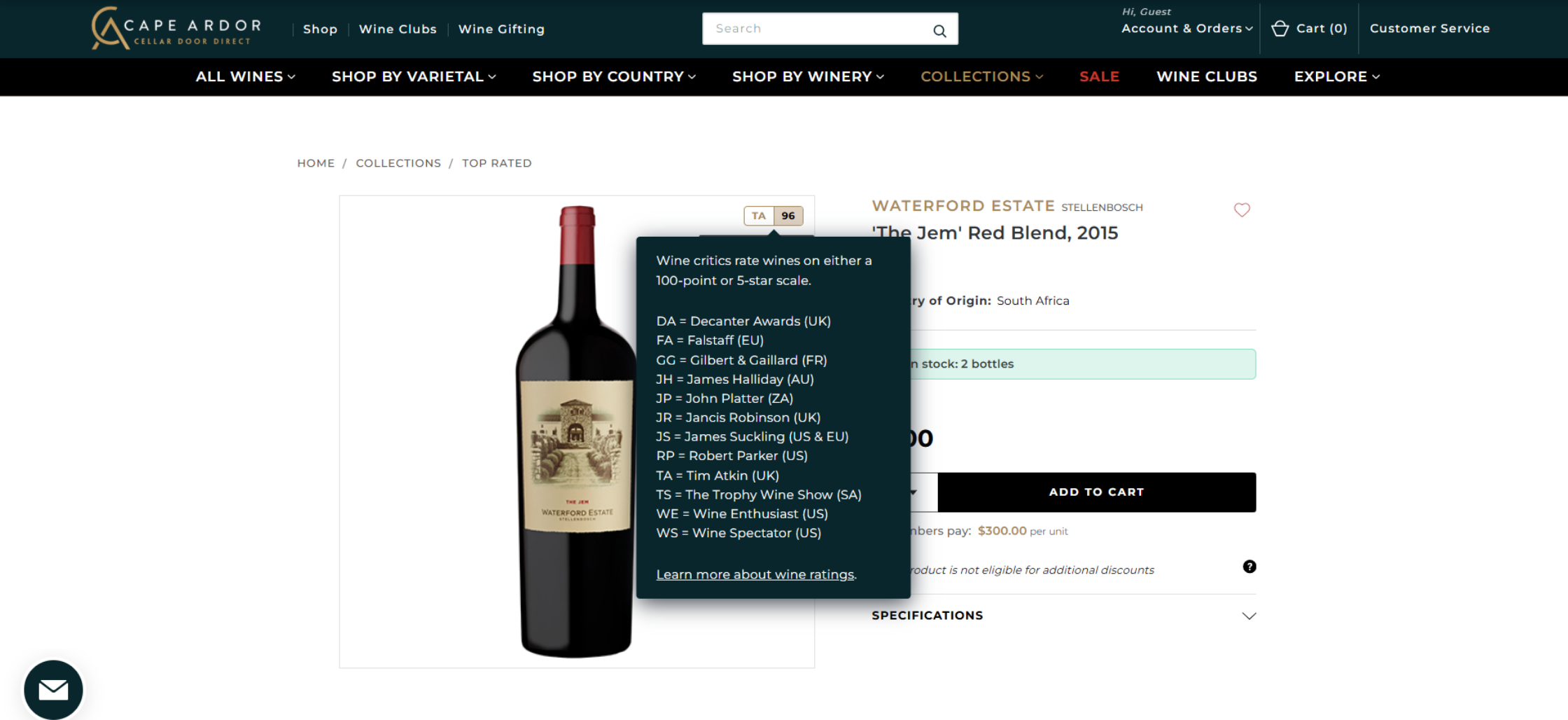
Hover over the wine ratings icon on any rated wine on Cape Ardor and you'll see a handy reference guide explaining the abbreviations we use for leading wine critics, publications, and competitions. The guide also includes their country of origin or primary area of expertise, making it easy to identify the source behind each rating displayed on our site.
Understanding the 100-Point Wine Rating System
The 100-point scale is the most widely used wine scoring system in the world. It is used by influential critics such as Robert Parker, Tim Atkin, James Suckling, Wine Spectator, Wine Enthusiast, Decanter, and many others.
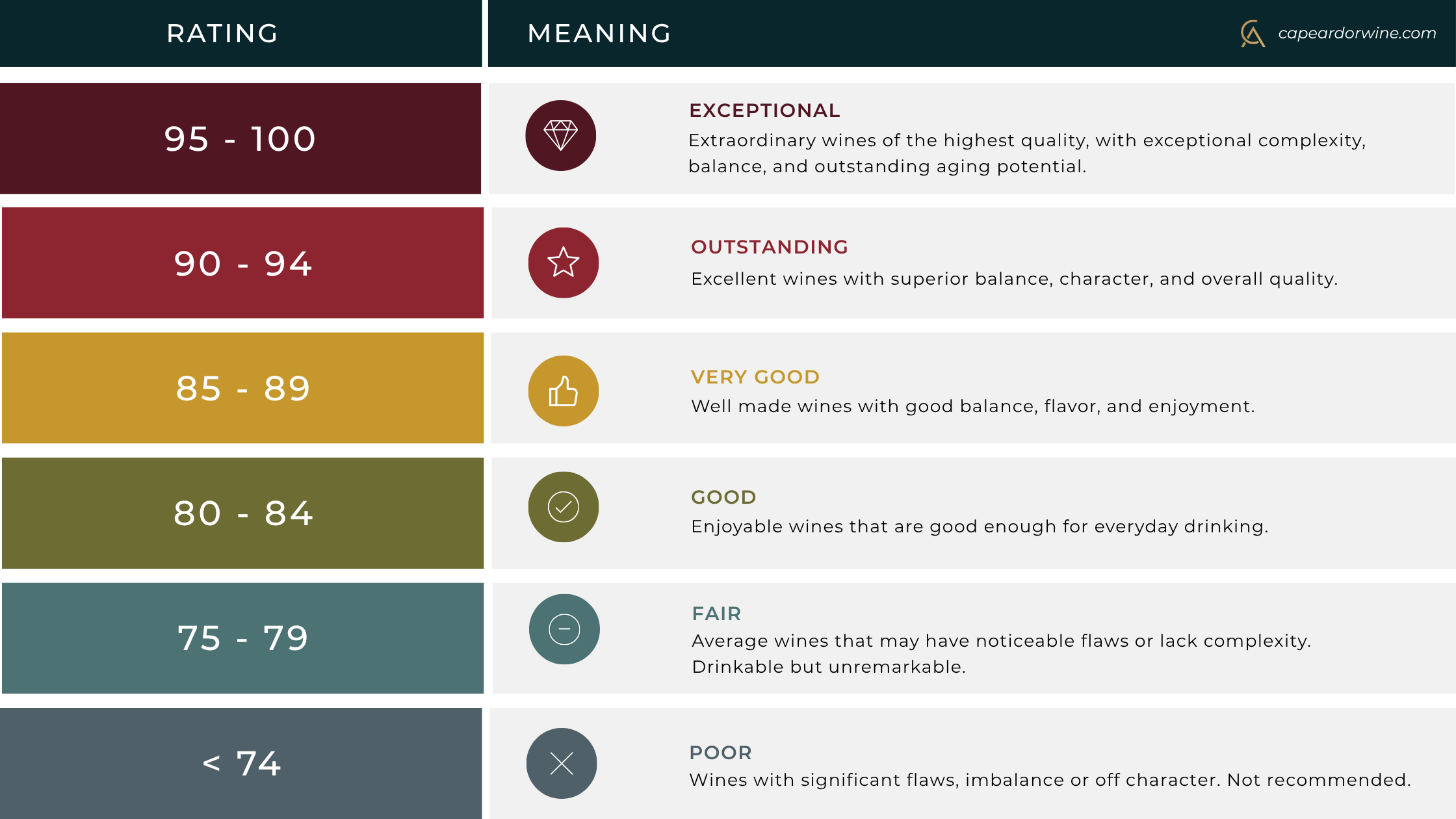
95–100 Points: Exceptional
These wines represent the highest level of quality. They display extraordinary complexity, balance, concentration, and aging potential. Wines in this range are often considered benchmark examples of their variety, region, or vintage.
90–94 Points: Outstanding
Wines scoring 90 points or higher are generally considered excellent. They show superior craftsmanship, strong varietal character, and exceptional drinking enjoyment. Many wine lovers specifically seek out wines in this range.
85–89 Points: Very Good
These are well-made wines with good balance, flavor, and structure. They often offer excellent value and are ideal for everyday enjoyment.
80–84 Points: Good
Enjoyable and sound wines that may be less complex or expressive than higher-scoring examples but still provide a satisfying drinking experience.
75–79 Points: Average
Drinkable wines that may lack distinction, complexity, or balance compared to higher-rated wines.
Below 75 Points
These wines may exhibit flaws, imbalance, or other issues that prevent them from reaching a higher quality standard.
Understanding the 5-Star Wine Rating System
The 5-star system is commonly associated with South Africa's most influential wine publication, Platter's South African Wine Guide.
5 Stars: Outstanding
Exceptional wines that represent the very best examples of their style. These wines are highly sought after and often among the country's finest.
4 Stars: Very Good
High-quality wines with excellent balance, complexity, and varietal expression.
3 Stars: Good
Reliable, enjoyable wines that offer solid quality and good drinking pleasure.
2 Stars: Fair
Drinkable wines that may be simple in style or lack significant distinction.
1 Star: Poor
Wines that do not meet expected quality standards.
What Is Considered a Good Wine Rating?
One of the most common questions wine buyers ask is: "What is a good wine score?"
As a general guideline:
-
95+ Points: Exceptional and often collectible
-
90–94 Points: Outstanding and highly recommended
-
85–89 Points: Very good and dependable
-
80–84 Points: Good everyday wines
For most wine lovers, wines rated 90 points or higher represent an excellent balance between quality and value.
Major Wine Critics and Their Rating Systems
Robert Parker (RP)
Robert Parker is one of the most influential wine critics in modern history. Through The Wine Advocate, he popularized the 100-point scoring system and helped shape wine buying decisions worldwide. Parker's ratings are especially influential for Bordeaux, Rhône Valley, and California wines.
Tim Atkin MW (TA)
Tim Atkin is a British Master of Wine, journalist, and critic renowned for his detailed regional reports. His annual South Africa Special Report is one of the most respected assessments of South African wines and wineries. He uses the 100-point scale.
James Suckling (JS)
Formerly a senior editor at Wine Spectator, James Suckling now operates one of the world's most influential independent wine review platforms. His ratings cover wine regions across the globe and are presented on the 100-point scale.
John Platter (JP)
John Platter established the influential Platter's South African Wine Guide, which remains one of the most trusted resources for South African wine enthusiasts. The guide uses a 5-star rating system and highlights the country's top-performing wines and producers.
James Halliday (JH)
James Halliday is Australia's most respected wine critic and author of the annual Halliday Wine Companion. His reviews and ratings are considered essential reading for anyone exploring Australian wines.
Jancis Robinson MW (JR)
Jancis Robinson is one of the world's most respected wine writers and critics. A Master of Wine and advisor to the late Queen Elizabeth II's wine cellar, her opinions carry significant influence across both Old World and New World wine regions.
Wine Awards and Competitions Explained
In addition to critic scores, many wines receive recognition through respected wine competitions and publications.
Wine Enthusiast (WE)
A leading American wine publication that uses the 100-point scale to evaluate wines from around the world. Wines scoring 90 points or higher are considered exceptional.
Wine Spectator (WS)
One of the most influential wine magazines globally. Its ratings and annual Top 100 Wines list are widely followed by collectors and enthusiasts.
Decanter Awards (DA)
The Decanter World Wine Awards is one of the largest and most prestigious wine competitions in the world. Wines are evaluated by panels of international experts and judged using the 100-point scale.
The Trophy Wine Show (TS)
One of South Africa's premier wine competitions, bringing together local and international judges to evaluate wines across a broad range of categories.
Winemag Prescient Reports (WM)
Winemag's annual reports, including the Prescient Cape Bordeaux Blend Report, are among South Africa's most respected independent wine evaluations. Wines are assessed through blind tasting to ensure impartiality.
Gilbert & Gaillard International Challenge (GG)
An internationally recognized wine competition that evaluates wines from around the world through rigorous blind tasting conducted by expert judges.
Falstaff (FA)
A leading Austrian wine and lifestyle publication that scores wines using the 100-point system. Its reviews are respected throughout Europe and beyond.
Should You Buy Wine Based on Ratings Alone?
Wine ratings are a valuable tool, but they should not be the only factor influencing your decision.
A 95-point Cabernet Sauvignon may receive extraordinary praise from critics, but if you prefer Pinot Noir or Chardonnay, it may not be the right wine for you.
When choosing a wine, consider:
-
Your personal taste preferences
-
Vintage
-
Food pairing opportunities
-
Price and value
-
Critic reviews and tasting notes
At Cape Ardor, we use ratings from leading critics alongside our own tasting experience and deep knowledge of each winery to help curate wines we believe our customers will truly enjoy.
Frequently Asked Questions
Is a 90-point wine good?
Yes. A wine scoring 90 points or higher is generally considered outstanding and represents a high level of quality.
Is a 95-point wine worth buying?
Often, yes. Wines scoring 95 points or more are considered exceptional and frequently display outstanding complexity, balance, and aging potential.
Are wine ratings subjective?
Yes. While critics use professional tasting methods and extensive experience, ratings ultimately reflect expert opinion. Personal preferences will always play an important role.
What does a 5-star Platter rating mean?
A 5-star rating in Platter's South African Wine Guide indicates an exceptional wine that ranks among the country's best examples of its style.
Which wine critic is the most influential?
Robert Parker is widely regarded as the most influential wine critic of the modern era, though critics such as Tim Atkin MW, James Suckling, Jancis Robinson MW, John Platter, and James Halliday are also highly respected.
Find Critically Acclaimed Wines
Many of the wines in the Cape Ardor portfolio have received outstanding ratings from leading critics including Tim Atkin, James Suckling, Robert Parker's Wine Advocate, Wine Spectator, Decanter, and Platter's South African Wine Guide. Our Top Rated Wines collection brings together some of the highest-scoring wines from South Africa, Australia, and New Zealand, making it easy to discover bottles that have earned exceptional praise from the world's most respected wine critics and competitions.
Whether you're searching for a highly-rated South African Cabernet Sauvignon, an acclaimed Australian Shiraz, or a world-class New Zealand Pinot Noir, our team is here to help you discover wines you'll love. Browse our Top Rated Wines collection to explore award-winning and critically acclaimed wines, all carefully selected for quality, character, and outstanding drinking enjoyment.
For personal recommendations or assistance selecting the perfect bottle, contact our expert customer service team at +1 888 812 2543.